
Inside Calhoun County Property Tax Records
Start with the Calhoun County Tax Assessor qPublic page. That site carries the parcel values. The Tax Commissioner handles billing and collection instead, and a paid bill never proves the assessment itself was right.
| Field | What It Shows | Where |
|---|---|---|
| Fair market value | Assessor's estimate of full value for tax administration. | Tax Assessor parcel card or notice. |
| Assessed value | Georgia's taxable starting value, generally 40% of fair market value. | Tax Assessor. |
| Exemptions | Approved reductions before millage is applied. | Tax Assessor. |
| Bill and payment status | Charges, due status, receipts, and possible delinquency. | Tax Commissioner. |
| Tax district | County, municipality, school, or other applicable levy context. | Parcel record and bill. |
A sale price is one fact from one transaction. It is not automatically the assessor's fair market figure. Georgia's basic formula stays simple: assessed value minus exemptions, multiplied by the applicable millage. The result still depends on the correct district and the correct billing year.
Read Calhoun qPublic with Care
qPublic names Adriane Ashley as Chief Appraiser. The main menu is plain. Search Records, Estimate Taxes, Exemptions, Forms, General Info, and Links each get their own tab. Across the Georgia qPublic family, searches run on owner name and location address. Parcel number and legal information work as well. Calhoun should follow the same pattern, so try the parcel number first.
| Search clue | Best use | Check before relying |
|---|---|---|
| Location address | Improved parcels with a stable situs address. | Directional, road-name, and number variants. |
| Owner name | Known individual or entity. | Initials, suffixes, trust or company spelling. |
| Parcel number | Carrying one tax identity between records. | Leading zeros and punctuation. |
| Legal information | Rural tracts and subdivision clues. | Land lot, district, acreage, lot/block, or plat. |
The assessor works from 10903 Dickey Street, PO Box 191, Morgan, Georgia 39866, with the phone at 229-849-4685. Public hours run 8:00 a.m. to 5:00 p.m. Lunch closes the office from noon to 1:00 p.m. The official Calhoun qPublic landing page also spells out the office's valuation role. Its Search Records tab opens the parcel search.
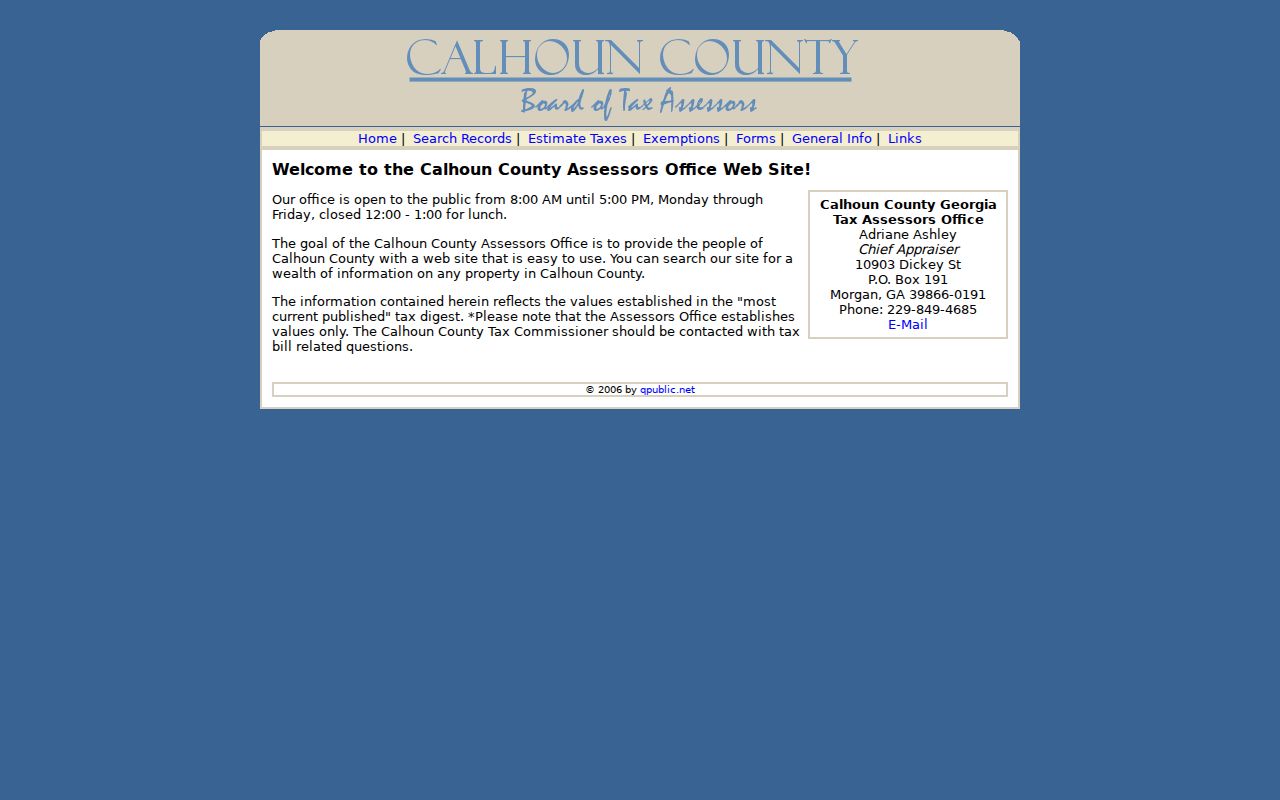
The Calhoun qPublic landing page confirms the right Georgia county and office before a parcel search begins. It displays no tax bill or parcel result itself.
Note: Ask for the current parcel card and annual notice rather than a verbal value alone.
Look Up a Calhoun County Tax Bill
The GovernmentWindow portal handles online payments for property taxes under Tax Commissioner Denise Varnum. It is the payment side of the ledger. Use the assessor's parcel number as the bridge between the two offices. Confirm the tax year first.
- Find the parcel in qPublic and copy its parcel ID, owner, situs, fair market value, and exemptions.
- Open the Tax Commissioner payment route and search the current billing year with the supported identifier.
- Compare the bill's district and exemptions with the assessor record; ask the relevant office about any mismatch.
- Review payment status and prior-year balances, then request official delinquency or sale information when needed.
- Assessed value
- The statutory portion of fair market value used as the starting tax base.
- Millage
- The levy applied to taxable assessed value; one mill represents one dollar per thousand dollars.
- Homestead exemption
- Approved relief tied to a qualifying owner's principal residence.
- Tax lien
- A legal claim arising from unpaid property tax, distinct from the annual value notice.
One Morgan Address, Two Tax Roles
Morgan hosts several county offices under one hub. Each request still needs the right destination. The Assessor values property and administers exemptions from Dickey Street. The Tax Commissioner, at 31 Court Street, Morgan, Georgia 39866, or 229-849-2970, handles bills, collection, payments, and delinquency questions. Send value evidence or appeal questions one way. Send receipts, payoffs, and bill status the other. A Georgia Open Records Act request can obtain an existing record. It cannot force an office to calculate a new tax estimate or decide an appeal outside the statutory process.
Calhoun Homestead Claims and April 1
Homestead relief in Georgia starts with one rule. You generally must own and occupy the residence on January 1. The Georgia Department of Revenue homestead guidance says to file with the local tax official. The filing window runs January 1 through April 1. Confirm procedure with the local office. State law offers standard, elderly, disabled-veteran, surviving-spouse, and other statutory categories. A portal label alone never proves eligibility. Keep the filed application and the approval or denial. Note the parcel number too, plus the year the exemption first appears on Calhoun County property tax records.
Note: Buying before January 1 does not by itself prove that every homestead condition or local filing step was met.
Agriculture and Timber Shape Calhoun Tax Records
Farming and forestry shape Calhoun County tax records. Special assessment vocabulary comes with them. Georgia DOR forms map the territory: PT-283A for agricultural current use, PT-230 for preferential agricultural assessment, PT-283T for timber, and PT-283TQ for quarterly timber reporting. Those forms only hint at record types. They never prove a parcel gets favorable treatment. Ask the Assessor which application, covenant, return, map, or acreage support sits behind the parcel. A sale, tract split, land-use change, or missed filing can undo the benefit. Timber or hunting rights may be separate. When the question outgrows valuation, reconcile the tax record with deeds and contracts.
Separate Tax Sales from Ordinary Sales
An unpaid-tax record, a levy, a sale notice, and a tax deed are different stages of one process. None of them is the same thing. For current status, request the bill and delinquency record from the Tax Commissioner. The Clerk of Superior Court holds the recorded instruments. Georgia tax-sale rules raise notice and redemption issues. A bidder or owner should verify deadlines and legal consequences, since a portal status is never marketable title.
Verify Calhoun's City and County District
A mailing address never settles the legal question of county, city limits, or tax district. Arlington is the local case to watch. That one city straddles Calhoun and Early counties. An Arlington address can therefore hide a Calhoun parcel. It can also attach the wrong tax bill. Before comparing millage rates or payment records, confirm the incorporated limits, the parcel number, and the district. Rural routes near Morgan, Edison, and Leary deserve the same caution. Treat mailing city, ZIP, situs, legal county, and tax district as five separate facts rather than one. When a boundary is uncertain, ask for an official municipal-limit or annexation map instead of trusting the label on an envelope.
Appeal a Calhoun County Assessment
The annual assessment notice is what starts the appeal clock. Georgia DOR's property-tax guidance lays out a 45-day window measured from the notice date. From there, an appeal can travel several routes. Options include the county Board of Equalization, a hearing officer for qualifying matters, or nonbinding arbitration. The notice itself names the filing office and the elections available, so follow it exactly.
A strong packet identifies the parcel and tax year and states the grounds being appealed. Attach comparable sales, photographs, and measurements. Repair evidence, a survey, an appraisal, or records showing a wrong parcel characteristic also belong in the packet. Save proof of timely delivery. Paying a bill and contesting an assessment remain two separate processes in Calhoun County.
Protect the 45-day window. File according to the date and instructions printed on the Calhoun notice. A portal inquiry or phone call does not necessarily preserve appeal rights.
Track a Calhoun Value from Notice to Bill
Keep a worksheet for each tax year. The assessment notice, parcel card, exemption record, and tax bill can arrive at different points in the annual cycle. So record the notice date, fair market value, assessed value, exemptions, district, millage, billed amount, payment date, and receipt number as each appears. When a figure changes, ask which office changed it and when the revision took effect. That habit prevents a common mistake. Comparing a current parcel card against a prior-year bill can read a timing difference as an error in the property records.
Ownership has its own lag. A recent deed may show up in the Clerk's index first. The assessor roll updates the owner or mailing address later. The recorded transfer is the better source for the transaction itself. The Assessor controls the tax roll. Give both offices the parcel ID and deed reference when correcting a mismatch. A mailing-address correction does not automatically change the valuation. It does not change the exemption or who owes an already issued Calhoun County tax bill.
Organize Evidence for a Calhoun Appeal
Match the evidence to the stated appeal ground. For value, use genuinely similar sales and explain the differences. Acreage, improvements, condition, access, flood exposure, timber, and agricultural use all matter. For uniformity, pull comparable assessments from the same tax year. For taxability, document the legal or factual basis for exclusion. Date every photograph. Identify the source of every measurement. Make repair estimates describe the defect rather than state a bare total.
Rural property rarely yields to a street-address comparison. Include the legal description, land lot and district, usable acreage, access conditions, conservation or agricultural covenants, improvement details, and any separately held timber interest relevant to valuation. Never assume a recorded sale price reflects an arm's-length transaction. The deed records must show the deed type and circumstances of the sale first.
File the appeal by the method printed on the annual notice. Keep a complete copy with delivery proof. Ask the Calhoun County Assessor what record will confirm receipt and which notice or hearing document comes next. Keep watching the Tax Commissioner account, because an appeal and a bill payment can move on separate schedules.