
Build a Calhoun County Deed Chain in Reverse
The first entry comes from the most recent conveyance. From there, log one row per transfer, letting each grantor become the grantee you chase in the older record, and keep the land description aligned at every step.
| Transfer point | Grantor to grantee | Deed type | Evidence retained |
|---|---|---|---|
| Newest recording | Prior owner to current grantee | As indexed | Date, instrument, book/page, description |
| Prior acquisition | Earlier grantor to prior owner | As recorded | Predecessor citation and land calls |
| Earlier transfer | Repeat with next predecessor | As recorded | Names, acreage, lot or district |
| Pre-web era | Continue in book or film | Historic form | Repository, volume, page, image |
Treat it as a worksheet only, never a title certificate. Estate actions, corrections, liens, and boundary instruments can all reshape the picture the timeline shows.
Cross Calhoun County's 1999 Online Divide
Deeds and plats from January 1, 1999 forward are computerized, scanned, indexed, and online, per the Calhoun Clerk. GSCCCA adds 1993 through 1998 data. The 1999 line concerns access. Ownership history runs much deeper.
Once you go offline, copy the book, page, date, parties, and predecessor language, then ask which vault book, film, or replacement index covers the span.
Online cutoff. Trace pre-1999 former owners through deed books, microfilm, archives, and cited predecessor instruments.
Search Calhoun Former Owners in GSCCCA
The official GSCCCA name-search page presents controls for party, instrument, county, neighboring-county, date, name, and page size.
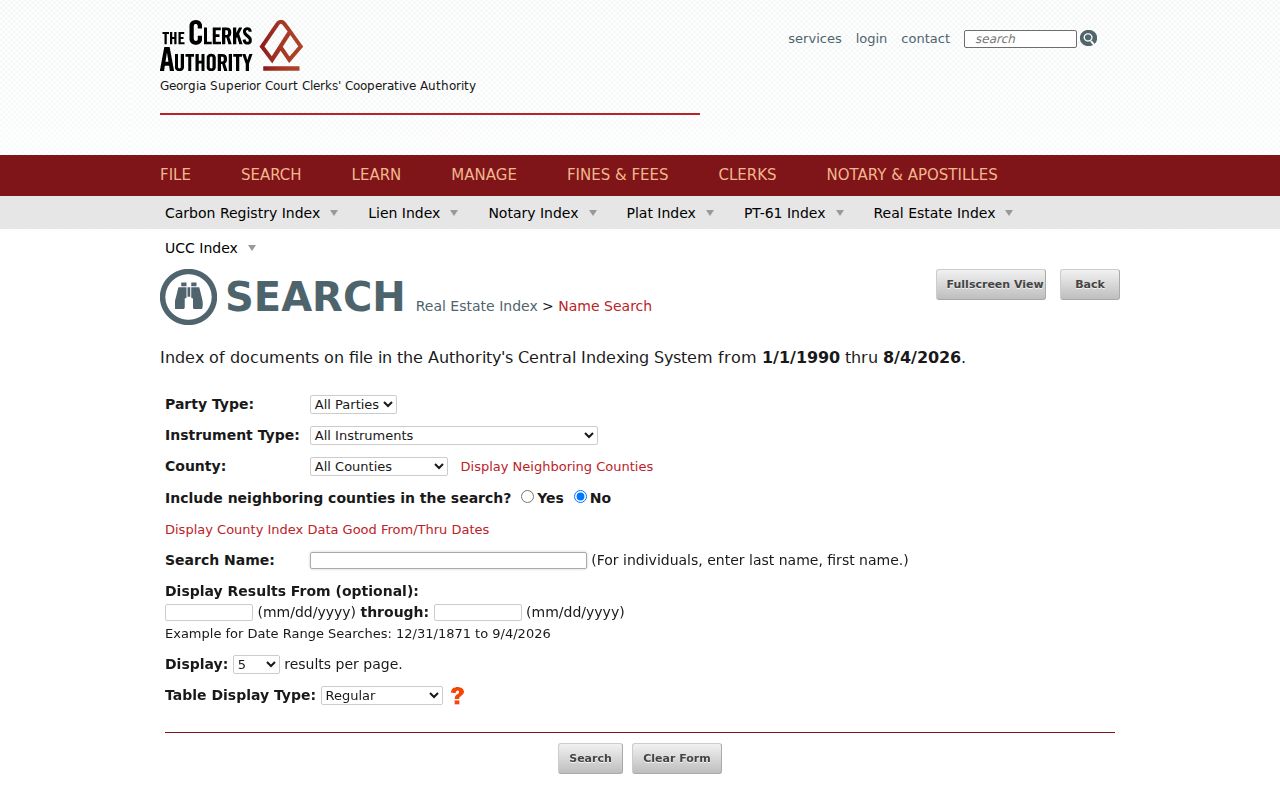
Run every spelling variant, including initials, married names, suffixes, and entity punctuation. Entities, trustees, and estates count too. Search both party roles. The search shows the route, not a finished chain, so compare each candidate against the county and the exact land description before adding that person.
Walk Calhoun County Ownership Backward
The method tracks people through their acquisition deeds while the legal description tracks the ground itself. That matters when one owner held several tracts.
- Find today's acquisition deed and verify the description.
- Copy the grantor, dates, deed type, book/page, and prior citation.
- Search that grantor as an earlier grantee and compare the land.
- Repeat, then carry the last firm citation into older books or film.
- Grantor and grantee
- The conveying and receiving parties.
- Chain of title
- The ordered instrument sequence for one tract.
- Legal description
- The land identity that survives address changes.
Continue Calhoun Previous-Owner Work Offline
The Georgia Archives county cards work best as finding aids rather than indexes. Archives research help points researchers to the Virtual Vault and FamilySearch. Images from before 1900 may not be name-searchable. That changes how you plan a search. Pull a firm deed citation first. Then search by county, series, volume, and year, since those fields carry you further than a name alone.
No complete pre-1999 Calhoun County deed-book inventory exists online, so the Clerk of Superior Court remains the practical route for deeper work. Visit the office at 31 Court Street, call 229-849-2715, or mail PO Box 69, Morgan, GA 39866. Published hours are weekdays 8 to noon and 1 to 5. Per GSCCCA, full searching is free at Superior Court offices, so a trip or a call costs nothing but time.
Reconstruct Calhoun Estate Transfers
A transfer without a sale often traces to probate. Search under the decedent, the estate, the executor or administrator, heirs, trustees, and any purchaser. Calhoun County Probate Court may hold wills, inventories, returns, and land-sale orders. The deed book records the conveyance itself. A caption alone proves nothing. Compare each probate description with the parcel and recorded instrument, and reach the court at 229-849-2115 or PO Box 87 in Morgan.
Test Calhoun's Courthouse-Fire Clues
Morgan's first two courthouses burned, in 1888 and 1920, and the present building dates to 1935. Ask which volumes survived, were reconstructed, re-recorded, or filmed. Fire alone proves nothing about a specific book. A newer deed's predecessor clause can bridge a failed name search, so confirm the exact volume with the Clerk and the Archives.
Note: Do not label a chain broken by fire unless the custodian confirms the fate of the exact volume.
Bridge Calhoun Former Owners with Land Descriptions
Old deeds rarely carry a modern street address. Subdivision land is followed through the subdivision name, phase, lot, block, plat book and page, replat, and vacation references. Rural Calhoun County tracts lean on other language. A point of beginning, courses and distances, monuments, acreage, land lot, district or GMD, roads, streams, and adjoining owners all identify the ground. Copy those terms exactly as written. They separate the right acquisition from another deed involving the same person.
A parcel split, recombination, annexation, or assessor-map conversion can mint a new parcel number. The deed trail survives. Work back to the parent tract. Note each exception or reservation. Timber, mineral, water, hunting, and access rights may have been conveyed separately from the surface, so a chain of surface owners proves little about them.
Plats help when lot lines shift. The Clerk reports modern plats online under the same January 1, 1999 cutoff, while older plat access must be confirmed with the office. The local library, at 229-835-2012, may point to newspapers, directories, or microfilm. The library hosts no parcel index.
Document Calhoun Prior Owners Reproducibly
Record the grantor and grantee. Add party role, instrument type, county, execution and recording dates, book, page, and instrument number. Log the legal description too. Include any consideration or PT-61 link, the image source, and the index's good-from date. Note spelling variants and why the description fits. The audit trail pays off. Another researcher can repeat the chain and catch a skipped deed.
If images are unavailable, send the Clerk a narrow request built on these citations and ask for electronic copies or the current certification process. Get a fee estimate first. A Georgia Open Records Act request should target existing records and date ranges, because the custodian need not create a chain or answer a historical question.
Test Every Calhoun County Ownership Link
A name in the right years does not prove a predecessor. Test every link. Compare the land description across both deeds. Watch for shifts in acreage, lot boundaries, reservations, or exceptions. Then examine the prior-instrument clause, execution and recording dates, and marital or joint-owner language. Also check any signature showing representative capacity. One instrument can convey several tracts. Decide which tract continues into the next deed before you accept the connection.
Search both sides of each transaction. A grantor search may expose a sale. A grantee search shows the acquisition that explains how the seller got the land. Middle initials, married names, suffixes, trustee wording, estate forms, and exact corporate names all matter. For an entity, the Georgia Corporations Division record helps separate legal names. It cannot replace the land deed itself. Probate can likewise explain a decedent's authority. It cannot prove that a conveyance was ever recorded in Calhoun County.
Build the timeline around legal effect and recording evidence, not tax-roll years alone. A deed may have been signed on one date and recorded much later. Corrective deeds, quitclaims, boundary-line agreements, deeds of assent, and court orders can all clarify a transfer. Such an instrument need not be an ordinary purchase. Record each instrument type exactly as it appears. Never convert a stated consideration into a claim of market sale.
Prepare a Calhoun Historic-Deed Request
A broad surname request rarely works with older Georgia repositories. Narrow it down instead. A strong Calhoun County request names the record series. Include the approximate year and both grantor and grantee. Add the deed book and page you are citing, plus any later instrument reference. Subdivision or land-lot details help the staff locate the right parcel. State the format you want and ask a few direct questions. Did the volume survive in the vault? Was it reconstructed or re-recorded, or does it exist only on microfilm?
Two tools make the request easier to build. The Georgia Archives catalog and its county cards identify the right series. FamilySearch catalog references often lead to digitized images. Those images may require free registration or a visit to an affiliate location. Some lack a searchable name index. Record the repository and the film or digital-item identifier in your ownership timeline. Add the volume, page, image number, and retrieval date. Those details keep a historic deed finding reproducible. The source itself may not be searchable by name.
Know the Reach of Calhoun Ownership Records
Older chains have real limits. The web cutoff is documented, but the earliest surviving book run stays unknown. Calhoun addresses and parcel IDs can shift after splits, mapping conversions, or annexation. The parcel number alone may mislead. Instead, lean on subdivision, lot, block, plat, land lot, district, acreage, roads, streams, and adjoining-owner calls. A recorded plat or replat can reconnect changing property outlines. Keep one distinction clear. A former owner of record is not always a former resident.
Once the chain names an instrument, the Calhoun deed-record route explains how to obtain it.
Lawful use. Trace former owners for house history, estate work, and property diligence. Never use historical data to track, harass, threaten, or target a living person.