
What Calhoun County Deed Records Show
The Calhoun County Clerk of Superior Court records deeds, mortgages, plats, financing statements, and other instruments that Georgia law requires. Each entry usually names the grantor and grantee. You also get the instrument type, recording date, and a book/page or instrument reference. Pull the deed image itself. It may add consideration, witnesses, notary details, a return address, tax-parcel clues, and the full legal description. That beats any directory listing or mailing address.
| Deed Type | What It Does | Common Use |
|---|---|---|
| Warranty deed | Conveys the stated interest with title covenants. | Ordinary purchase and sale. |
| Quitclaim deed | Conveys whatever interest the signer has, without the same covenants. | Family transfers and title cleanup. |
| Security deed | Secures repayment rather than serving as the buyer's conveyance. | Georgia real-estate financing. |
| Executor or assent deed | Moves an estate interest under probate authority. | Estate administration. |
| Deed under power | Records a transfer following exercise of a power of sale. | Foreclosure research. |
Separate conveyances from encumbrances. A warranty or quitclaim deed moves an ownership interest. A security deed, lien, easement, or restrictive covenant burdens or shapes the land instead, and its beneficiary need not be the fee owner. Read the instrument itself rather than trusting a short index label.
Calhoun's January 1999 Online Divide
Calhoun's online divide lands on January 1, 1999. The Clerk reports deeds and plats scanned and indexed online from that date. The GSCCCA Real Estate Index covers statewide transactions beginning in 1999, with 1993 through 1998 material still being added. So treat 1999 as a practical starting line. It is not proof that earlier Calhoun County deed records vanished.
Say a modern deed cites an older book and page. Copy that reference exactly. Ask the Clerk whether the volume sits at the counter or on film. The Georgia Archives catalog offers another route. A missing web result means change channels. It never means the transfer failed to happen.
Note: Coverage dates describe the index; image availability and completeness can differ by county and account.
Search Calhoun Deeds by Party and Date
The GSCCCA name search is the main online grantor-grantee route for Calhoun County. Select the county first. Enter individuals as last name, then first. Choose the party and instrument controls that fit the transfer, with a date range broad enough to catch delayed recording or name variations.
| Observed control | How it narrows the deed index |
|---|---|
| Party type | Separates the transferring and receiving sides where the option is available. |
| Instrument type | Focuses results on deeds, liens, plats, or another recorded class. |
| County | Limits the statewide system to Calhoun County. |
| Search name | Accepts an individual's last name and first name; entity punctuation and suffixes deserve variants. |
| From and through dates | Frames the likely recording period in month/day/year format. |
| Results and display controls | Change pagination and table presentation without changing the underlying record. |
Statewide results can leave display fields blank for Calhoun County entries. Verify any hit against the instrument image. The Clerk's own index works as a backup. The official GSCCCA name-search screen carries the statewide controls that frame a Calhoun County deed-record search.
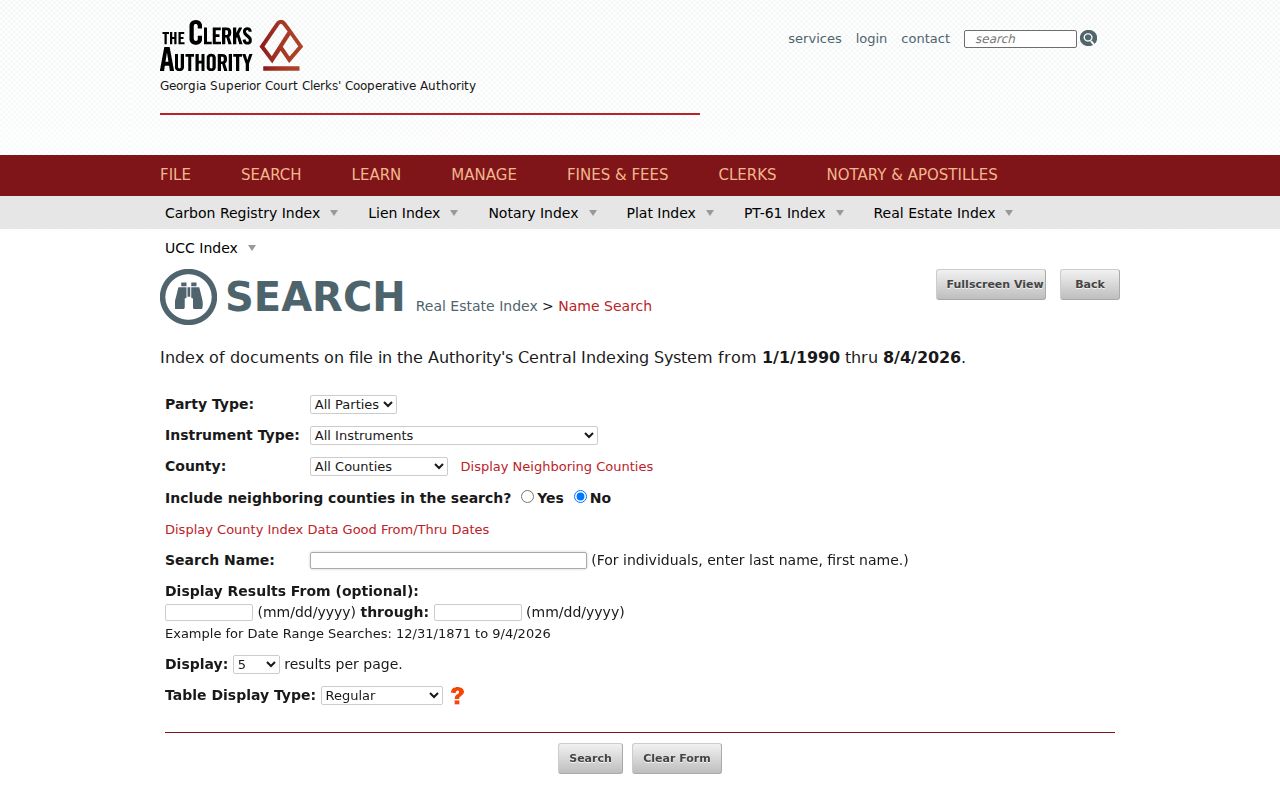
The controls cover party, county, instrument, name, date, and display. For document substance, rely on the deed image and the local Clerk.
Following Calhoun's Grantor-Grantee Index
Build the chain one transfer at a time. Start with the newest reliable conveyance, preserving its land description and recording reference. Use the parties to step backward. When a result goes missing, search spelling variants, initials, former entity names, and both sides of the transaction.
- Use the assessor name or newest known owner to find that party as grantee.
- Open the matching deed and record the grantor, legal description, date, instrument type, and book/page or instrument number.
- Search that grantor as an earlier grantee, confirming that the land description follows the same tract.
- Repeat until the trail crosses the online cutoff, then carry the last book/page reference to the Clerk or archives.
- Grantor
- The party transferring the stated interest.
- Grantee
- The party receiving the stated interest.
- Chain of title
- The ordered sequence of instruments affecting the same land.
- Book/page and instrument number
- Recording references used to retrieve the document; preserve whichever the index supplies.
Let the Legal Description Control the Match
In rural Calhoun County, address-only matching breaks easily. A deed may describe land by district or Georgia land lot, by acreage, by metes-and-bounds calls, by adjoining owners, or by a recorded lot and block. Street addresses change. The older description elements carry straight through successive deeds.
Cross-check the deed against the assessor parcel identifier and any cited plat. Phrases like “being the same property conveyed by” can bridge you straight to a predecessor deed. Timber, access, hunting, mineral, and water interests travel separately. The surface parcel owner may not hold every interest.
Calhoun Plats Complete the Land Record
Recorded plats, replats, dedications, vacations, and easements can decode a deed's abbreviated lot reference. The GSCCCA property search offers subdivision, county, and date controls for participating counties. Calhoun's exact coverage varies. Confirm it with the Clerk. When the online form returns nothing dependable, bring the deed's plat citation to the counter.
A plat shows lots, blocks, roads, and bearings. It replaces no boundary survey. Nor can it prove an occupation line matches the legal boundary on the ground.
Note: Preserve subdivision spelling exactly, then try abbreviations and predecessor subdivision names if the first search fails.
From Courthouse Fires to Archival Deed Books
Morgan's first courthouse burned in 1888. Its second burned in 1920. The present building dates to 1935 and was renovated in 1972, per the Digital Library of Georgia courthouse record. Those fires argue for verifying a volume's survival, not for assuming every early deed record perished.
For a pre-1999 chain, ask the Clerk about deed-book, index, film, and reconstructed-volume finding aids. Georgia Archives Virtual Vault county cards help too. FamilySearch catalog entries sometimes carry registration or image restrictions. A precise prior book/page citation gives staff a far better start than an owner name.
Estate Papers Explain Non-Sale Transfers
An ownership chain sometimes jumps for a plain reason. The owner died, and the land moved through an estate instead of a sale. Wills, inventories, returns, land-sale orders, and deeds of assent can bridge the gap between the deceased owner and the heirs. Those heirs later conveyed the property. Calhoun Probate Court records pair well with the Georgia Archives and FamilySearch probate collections. All three sit alongside the deed index rather than replacing it. Match names, dates, tract descriptions, and the fiduciary capacity of each signer. Estate papers rarely look like a normal sale deed.
Monitor New Calhoun Filings with FANS
GSCCCA FANS takes a different approach to staying current. The free service sends alerts when new activity matches a name, address, or document you follow. It works well after a purchase or while managing family land. It does not replace a careful pass through the deed index. GSCCCA itself cautions that notifications may not be comprehensive, current, or accurate. The statewide numbers back up the tool's popularity. GSCCCA reports 96,593 users, 209,648 requests, and 474,289 matches. Those are state totals, not Calhoun County filing counts. A suspicious instrument may still surface. Periodic index checks and a prompt call to the Clerk remain the stronger response.
Get a Calhoun County Deed Copy
Getting an image online depends on county participation, account level, and payment. GSCCCA lists Premium service at $29.95 per month per user. Printed pages cost $0.50 each. Verify current pricing on its official Premium Search page. The statewide eCertification service offers another route to eligible digital certified copies.
The local fallback is the Clerk at 31 Court Street, Morgan, Georgia 39866, telephone 229-849-2715. Published hours run Monday through Friday, 8:30 a.m. to 5:00 p.m. The office closes for lunch from noon to 1:00 p.m. Ask whether the image you need is available online, at the free courthouse terminal, by written request, or as a certified copy. Have the details ready: party names, an approximate recording date, instrument type, and the book and page or instrument number. Confirm the current copy and certification charge before you order.
Recorded is not guaranteed title. The index shows instruments accepted for recording. It is not a title opinion, and unrecorded interests, defects, or later instruments may affect the land.
Note: Full GSCCCA database searching is available free at Georgia Superior Court offices, even when internet image access requires an account.
Reconcile Each Calhoun Deed Index Hit
Treat every index row as a finding aid. Record enough detail to rerun the search later. Save the county, the party names exactly as displayed, each party's role, and the instrument type. Note the recording date, the execution date when shown, the book and page or instrument number, and the image-page count. Then compare the document itself: return address, preparer, witnesses, notary, consideration language, parcel reference, legal description, and any cited plat or predecessor deed. Similar names show up constantly. A shared surname alone should never carry a Calhoun County chain.
Entity-owned land calls for one more step. Pull the Georgia Secretary of State business record for the entity's exact legal name. Note any former names too. Return to the deed index with those variants in hand. For a trust or estate, note the capacity in which each signer acted. An executor, administrator, trustee, individual beneficiary, and corporate officer can all appear in related deed records. They are not interchangeable owners of record.
Watch for instruments filed beside the conveyance. Security deeds, cancellations, assignments, liens, easements, and covenants belong on a separate inventory list. They can shape financing, access, use, or priority. But they never form links in the ownership chain. A careful Calhoun deed-record review follows the land description across conveyances while tracking encumbrances in parallel.